
As the whole sport world is currently engaged in watching Wimbledon 2021 after its hiatus last year, I thought of posting the academic work that I have done during my Sport Management studies in 2019.
Since television emerged as the global dominant medium between 1960 and 1980, the sport has played a major role in the growth of tv. Sequentially, together with commercial sponsorship, television transformed the sport, prompting changes in its presentation, cultural form, rules and bringing significant new income (Whannel, 2009). Television played an important role in the economic transformation of sport and was central to the globalisation of sport. Sport is the focal point of intense commercial activity and it has been reshaped many times to meet the requirements of media and promotional parts of the industry. ATP stands for Association of Tennis Professionals, It is a men’s professional tennis governing body. There is a tennis enthusiast worldwide who wants to consume sport. According to BBC, in 2015, men’s tours registered 973 million viewers and women’s tennis attracted 395 million viewers.
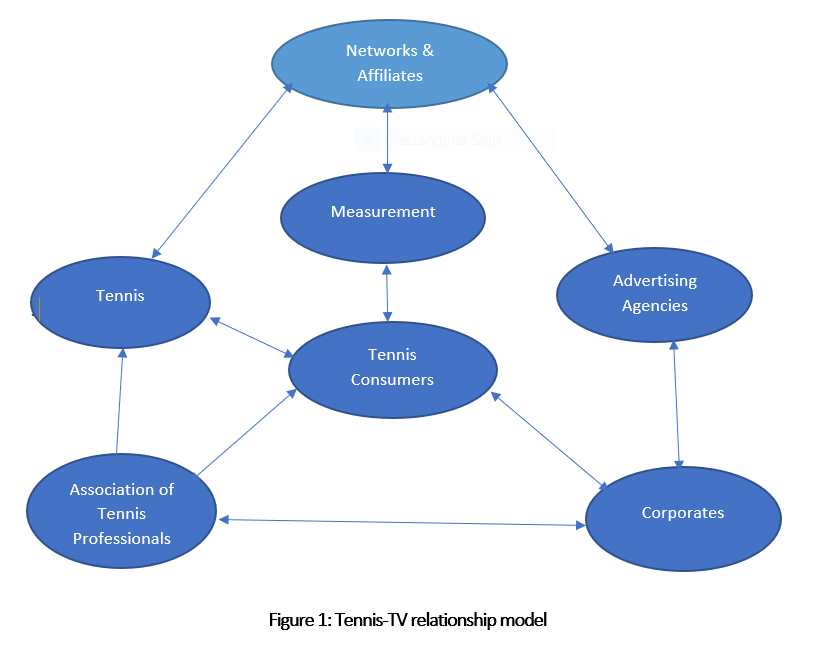
Broadcasting live tennis matches on TV results in substantial revenue for ATP. TV networks and affiliates purchase the rights from ATP to broadcast tennis matches live on their channels. For example, channels like ESPN and Sky had the right to broadcast ATP matches until 2017. The network depends on programming that has the potential to captivate and capture an audience to attain a reasonable return on investment. TV networks and their affiliates across the world will sell airtime to advertisers during these live sporting events. Big corporations worldwide want widespread exposure, glamourous high-profile associations, strong demographics, and the attention of an upscale audience. These corporations want to utilize sporting events as a promotional tool for their products, services and companies.
Advertising agencies act as a middleman or broker. Agencies issues link between the networks who telecast live sporting events and the corporate clients who want to purchase advertising time during the broadcast of such sporting events (Shilbury et al., 2014). Advertising agencies analyse audience profiles created by the measurement agencies. Based on the measurements, these advertising agencies will advise the corporates on their advertising strategies to attain their goals.
Vertical integration strategy and its impacts on sport broadcasting value chain
Figure 2 gives an overview of the different factors operating at different levels in the sports broadcasting value chain (Solberg and Helland, 2011, pg. 19). ATP is the governing body of different tennis tournaments across the world and hence are the producers of the sports content. Various TV and radio networks who have purchased the rights of broadcasting the tennis tournaments are the producers of TV programmes. Cable operators and satellite, terrestrial channels and digital platforms like Kayo Sports, Optus Sport, etc. are distributors of TV programmes. Tennis enthusiasts and sports enthusiasts, in general, are the viewers of these tournaments.
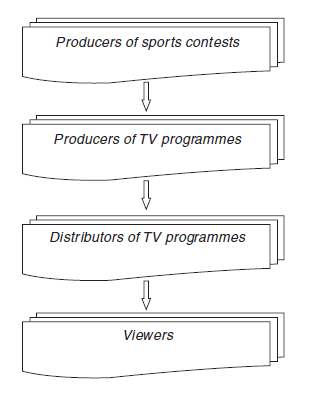
The sport broadcasting value chain (Solberg and Helland, 2011)
When an organisation or a firm takes part in more than one stage of the production or distribution of services or goods it is known as ‘vertical integration’ (Solberg and Helland, 2011). ATP started to integrate with activities on a level which are closer to viewers since 2006. This is called forward or downward integration. In the pe-integration scenario, rather than broadcasting ATP tournaments by themselves, ATP sold broadcasting rights of live ATP tennis matches to Amazon (Bickerton, 2019). Amazon has secured rights for coverage of 37 ATP tour tournaments from 2019 until 2023. From the deal with Amazon, it’s obvious that the integration can be improved from ATP to decrease the collaboration with other streaming services like Amazon Prime and promote their streaming service, Tennis TV. Implementing a vertical integration strategy will mean reduced transaction costs for ATP. They can perform the broadcasting of ATP tour tournaments by themselves to increase profitability. It will also mean that inefficiency issues because of lopsided information between buyers and sellers will be reduced. From combined operations, maintenance of stable throughput and sharing of activities in a value chain will mean that economies of scale advantages can be internalised within ATP.
ATP currently has their own direct to consumer, over the top (OTT) streaming service, tennis tv, which they launched in 2006. OTT uses the internet to receive the sports content, essentially by-passing cable, satellite, and broadcast tv service providers (Atpmedia. tv, 2019). “Tennis TV is the official video streaming service of the ATP Tour” (Tennistv.com, 2019). Viewers can watch live tennis on multiple devices like mobile, computer and tablet and a TV – via Amazon Fire TV, Roku, Apple TV, Google Chromecast, Samsung Smart TV, PlayStation 4, Android TV and Xbox One.
ATP has done well to integrate themselves and have their digital output in the form of Tennis TV. It shows that they are following industry trends. For example, NFL has revealed in 2018 that consumption of NFL games on digital platforms has increased by a whopping 147 per cent, whereas TV devices also registered a 54 per cent rise from 2017 (Carp, 2018). Similarly, the impact of vertical integration on the value chain in tennis is visible. ATP’s annual revenue before integration in 2006 was 52 million US dollars, which increased to 107.1 million US dollars in 2014 (Kaplan, 2015). Tennis TV will only get more followers in future as it shows real-time stats, follows the players, shows their interviews and journeys to the fans who are no longer limiting their viewership to just the live tennis matches but are also seeking out videos of top game moments, which shows the 80% increase in sports highlights video views on different YouTube channels (Potter, 2019). Releasing such videos on Tennis TV will only increase the number of consumers in the future which will help ATP in increasing their annual revenues.
 Sports Geek